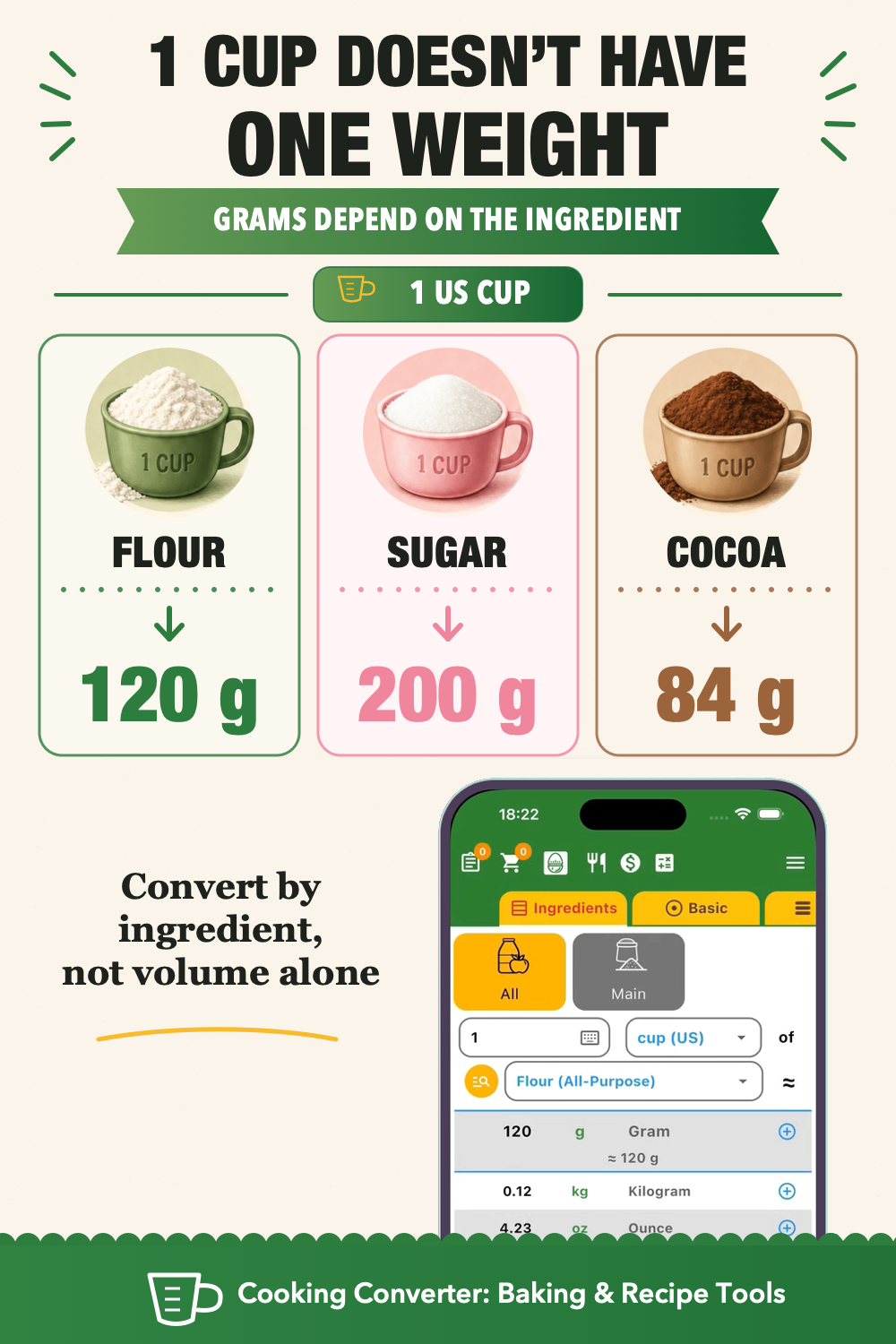
If you’ve ever searched “how many grams are in a cup?” and found several different answers, nobody necessarily got the math wrong. The missing detail is the ingredient. Even the same ingredient can have different weights depending on how it is prepared, measured, or shaped.
Why one cup doesn’t have one weight
A cup measures volume: how much space something takes up. Grams measure mass, or what your kitchen scale reads. To move from one to the other, you also need to know the ingredient’s density.


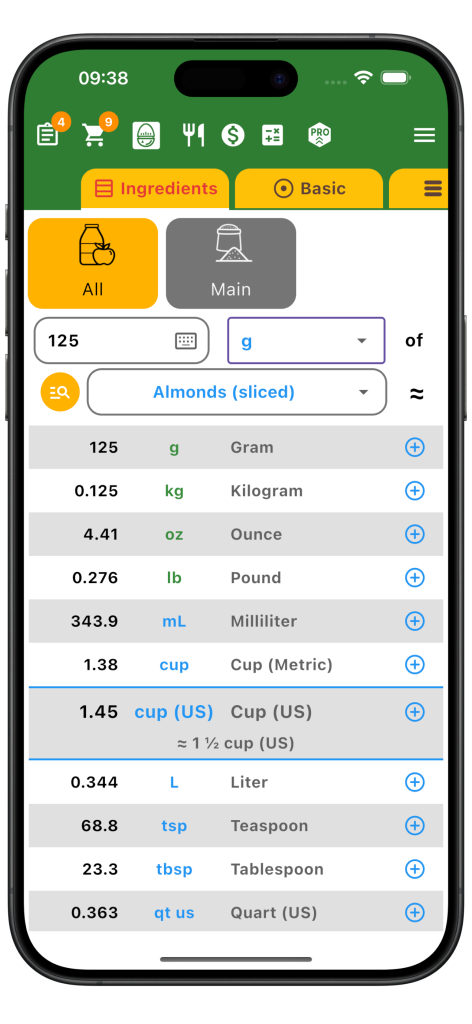
Think about filling the same cup with feathers and pebbles. The volume is identical, but the weight clearly isn’t. Your pantry works the same way, just less dramatically. Granulated sugar settles into a cup quite densely, while flour and cocoa powder hold more air between their particles. That is why there can’t be one reliable cups-to-grams number for every ingredient. The shape of the ingredient is also important. For example, one cup of sliced almonds weighs a different amount from one cup of whole almonds. Cooking Converter includes many different ingredient variations in its database, so you can choose the form you’re actually using and get a much more accurate conversion.
Three useful starting points:
- 1 US cup all-purpose flour = 120 g
- 1 US cup granulated sugar = 200 g
- 1 US cup unsweetened cocoa powder = 84 g
The difference is big enough to matter. If you treated every cup as 200 grams, for example, your cake could end up with far too much flour or more than twice the cocoa the recipe intended.
Even ingredient-specific conversions are best treated as practical reference values, not universal scientific constants. Flour can settle in its container, cocoa can clump, and sugar crystals may vary slightly by brand. The way you fill the cup matters too. Dipping a measuring cup straight into a bag of flour can compress it and give you more flour than gently spooning it in and leveling the top. Different recipe writers may therefore use slightly different gram values.
When a recipe already gives a weight, follow that number. It reflects the recipe writer’s own standard. When you only have cups, choose the correct ingredient before converting. It is also worth checking which kind of cup the recipe uses; the figures above are for a US cup. Our cooking unit converter app supports both metric and US cups.
A simpler way to convert while cooking
This is where a kitchen scale makes life easier. Place your bowl on the scale, tap tare, and add the ingredient until you reach the target weight. There is less guesswork, less washing up, and your results are easier to repeat.
Cooking Converter keeps the ingredient in the calculation, so flour isn’t treated like sugar and sugar isn’t treated like cocoa. Choose the exact ingredient, enter the amount, and convert cups to grams or grams to cups. It is a handy option when a recipe uses unfamiliar units or leaves out metric measurements. If you are also changing the number of portions, see how to scale a recipe for any number of servings.
Next time a recipe makes you pause at “one cup,” try the ingredient-specific conversion and get back to cooking.
Explore Cooking Converter for Android or Cooking Converter for iPhone and iPad.
Download Cooking Converter from the App Store or Google Play.