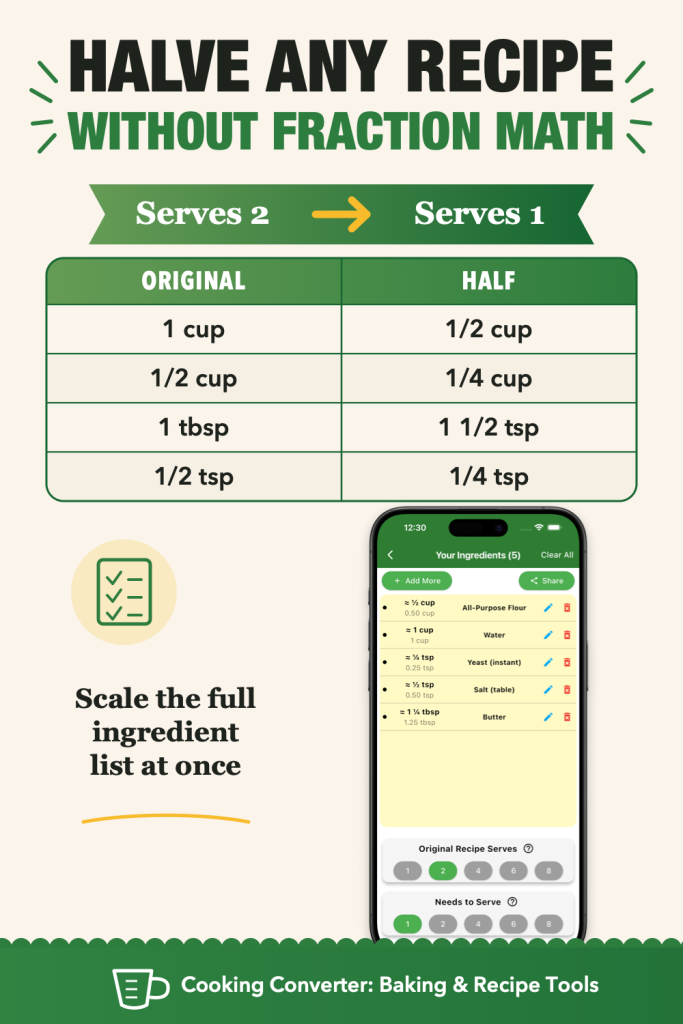
Scaling a recipe is useful when the number on the page does not match the number at your table. You might be cooking for two, feeding extra guests, or preparing portions for the week. The idea is simple: multiply every ingredient amount by the same factor so the recipe keeps its balance. Cooking Converter can scale the full ingredient list for you.


The one number you need:
Take the servings you want and the recipe’s original serving count:
Target servings ÷ original servings = multiplier
Multiply each ingredient amount by that number. If a recipe serves 2 and you need 1, the multiplier is 1 ÷ 2, or 0.5. One cup becomes 1/2 cup, 1/2 cup becomes 1/4 cup, and one tablespoon becomes 1/2 tablespoon—or 1 1/2 teaspoons when using US kitchen measures.
The same method works when you are making more. If a recipe serves 4 and you need 6, the multiplier is 6 ÷ 4, or 1.5. Two cups of broth become 3 cups, and one teaspoon of seasoning becomes 1 1/2 teaspoons. Increasing and reducing use the same rule; only the multiplier changes.
Scale the full list before you cook
Work through the entire ingredient list before turning on the stove. Write the new amount beside every item, including oil, seasoning, leavening, sauces, and small additions that are easy to overlook. Scaling the main ingredient but forgetting the salt or baking powder can change the result, not just the number of portions.
If a new amount looks awkward, switching units often makes it easier to measure. Half a tablespoon is simpler as 1 1/2 teaspoons, for example. For ingredients listed by weight, multiply the grams directly. If you need to convert cups to grams first, use the value for the specific ingredient. You can still taste and adjust flexible ingredients such as salt, chili, and garnish near the end, but begin with the properly scaled amount.
Eggs, pans, and other awkward details
Eggs do not always divide neatly. If you need half an egg, crack it into a bowl, whisk the white and yolk together, then measure out half by weight or volume.
Baking needs a little extra attention because ingredient quantity is only part of the picture. A larger or smaller batch may need a different pan, and a change in batter depth can affect cooking time. Choose a pan that keeps the depth reasonably close to the original recipe, follow the usual signs of doneness, and start checking earlier rather than multiplying the baking time.
For a short ingredient list, doing the calculation yourself may be all you need. When a recipe is longer, Cooking Converter can handle the repeated work. Enter the full ingredient list, set “Original Recipe Serves” and “Needs to Serve,” and the app updates the amounts together.
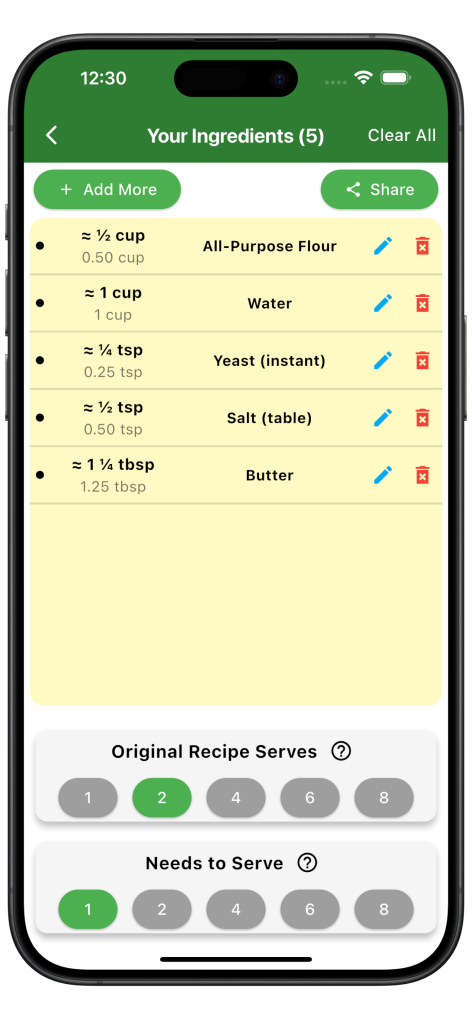
The next time a recipe makes too much or too little, use whichever approach feels easiest—and let Cooking Converter take care of the list when you would rather get straight to cooking.
You can scale a recipe with Cooking Converter for Android or Cooking Converter for iPhone and iPad.
Download Cooking Converter from the App Store or Google Play.